
 简体中文
简体中文 English
PVC Hoses
PVC Hoses: Everything You Should Know
Table of Contents
We must recognize the importance of PVC hoses in various industries worldwide. These hoses play a crucial role in multiple sectors, providing reliable transportation for fluids and materials. They are widely used in agriculture, industrial facilities, chemical processing, and HVAC systems. Therefore, understanding the basics of PVC hoses and their different types is essential.
PVC hoses are known for their versatility, cost-effectiveness, and resistance to corrosion and abrasion. Made from durable synthetic material, they are designed to transport liquids, gases, and even solid materials. The properties of PVC make it an ideal choice for many applications—it is lighter and more economical than rubber hoses, which it has largely replaced in numerous uses.
This article provides a comprehensive understanding of PVC hoses and their applications. It also highlights key factors to consider when selecting the right product for specific needs. Readers will gain fundamental knowledge about PVC hoses and their advantages. Additionally, we will discuss the key differences between PVC hoses and polyurethane hoses. By the end of this article, readers will be able to make informed decisions when choosing the right product for their applications and identify the ideal specifications for their requirements.
What is a PVC Hose?
A PVC hose (Polyvinyl Chloride hose) is a flexible tube made from synthetic thermoplastic polymer. These hoses are ideal for transporting fluids, gases, and solid materials across various industries.
A PVC hose typically has a multi-layer structure:
· The inner layer, usually made of PVC, provides a smooth pathway for material flow.
· The reinforcement layer (often made of polyester, nylon, or steel wire) adds strength and pressure resistance.
· The outer layer protects the hose from external factors like abrasion and chemicals.
Manufacturing Process
The production of PVC hoses involves four main steps:
1. PVC Compounding – Mixing PVC resin with plasticizers, stabilizers, and other additives.
2. Extrusion – Melting and shaping the mixture into a continuous tube, then cooling it to solidify.
3. Reinforcement – Adding layers (e.g., braiding, spiral winding) for strength.
4. Curing & Finishing – Finalizing the hose structure for durability.
Advantages of PVC Hoses
✔ Highly flexible – Easy to handle and install.
✔ Durable – Resistant to abrasion, impact, and tearing.
✔ Chemical-resistant – Suitable for various industrial applications.
✔ Weather & UV-resistant – Ideal for outdoor use.
✔ Lightweight & cost-effective – More affordable than rubber hoses.
✔ Low maintenance – Simple to clean and maintain.
Types of PVC Hoses & Their Applications
PVC hoses come in different types, each designed for specific purposes. Below, we categorize them into six main types, discussing their features, uses, pros, and cons.
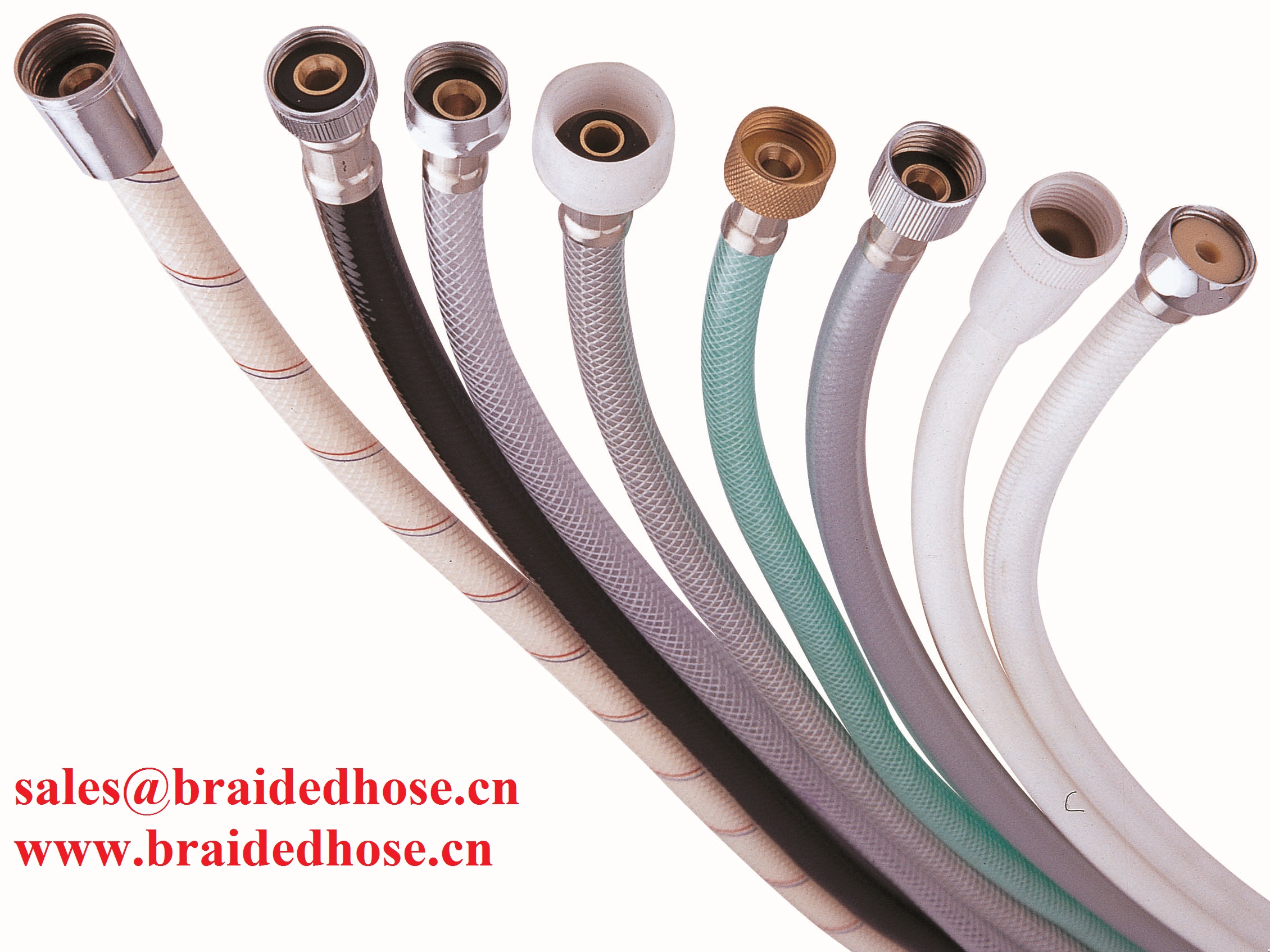
1. PVC Braided Hose
· Construction: PVC + reinforced textile braiding (polyester/nylon).
· Applications: Plumbing, gardening, water supply, industrial use.
· Pros: Versatile, durable, chemical-resistant, cost-effective.
· Cons: Limited temperature range, UV degradation over time.
2. PVC Layflat Hose
· Construction: Flat, foldable PVC design.
· Applications: Agriculture (irrigation), dewatering, flood control.
· Pros: Compact storage, lightweight, easy to deploy.
· Cons: Not for high-pressure/high-temperature use, prone to wear.
3. PVC Wire-Reinforced Hose
· Construction: PVC tube + steel wire spiral + smooth PVC cover.
· Applications: Construction, mining, material handling.
· Pros: High suction capability, transparent (visible flow), high-pressure resistant.
· Cons: Can kink, not for extreme temperatures.
4. Reinforced PVC Hose
· Construction: PVC inner tube + multi-layer reinforcement + outer cover.
· Applications: Chemical processing, oil, mining, machinery.
· Pros: High-pressure resistance, long lifespan.
· Cons: Not for high heat or certain chemicals.
5. PVC Suction Hose
· Construction: PVC tube + rigid spiral reinforcement.
· Applications: Wastewater management, agriculture, marine use.
· Pros: Handles vacuum/suction well, collapse-resistant.
· Cons: Can clog with debris, not for high-pressure/high-heat use.
6. PVC Garden Hose
· Construction: PVC inner tube + polyester/nylon reinforcement.
· Applications: Gardening, outdoor cleaning, water supply.
· Pros: Lightweight, flexible, affordable.
· Cons: Prone to kinking, lower pressure rating.
Conclusion
This article explored the world of PVC hoses, covering their composition, types, advantages, and limitations. While PVC hoses are excellent for many applications, they are not suitable for high-temperature environments (where rubber hoses may be better).
When selecting a PVC hose, consider:
· Pressure & temperature requirements
· Chemical compatibility
· Environmental conditions