
 简体中文
简体中文 English
Flexible Hoses for Toilets
Stainless Steel Braided Flexible Hoses for Toilets
This is a systematic introduction to stainless steel braided flexible hoses for toilets, covering structure, selection, installation, maintenance and precautions for your procurement and construction reference:
Basic Structure and Function
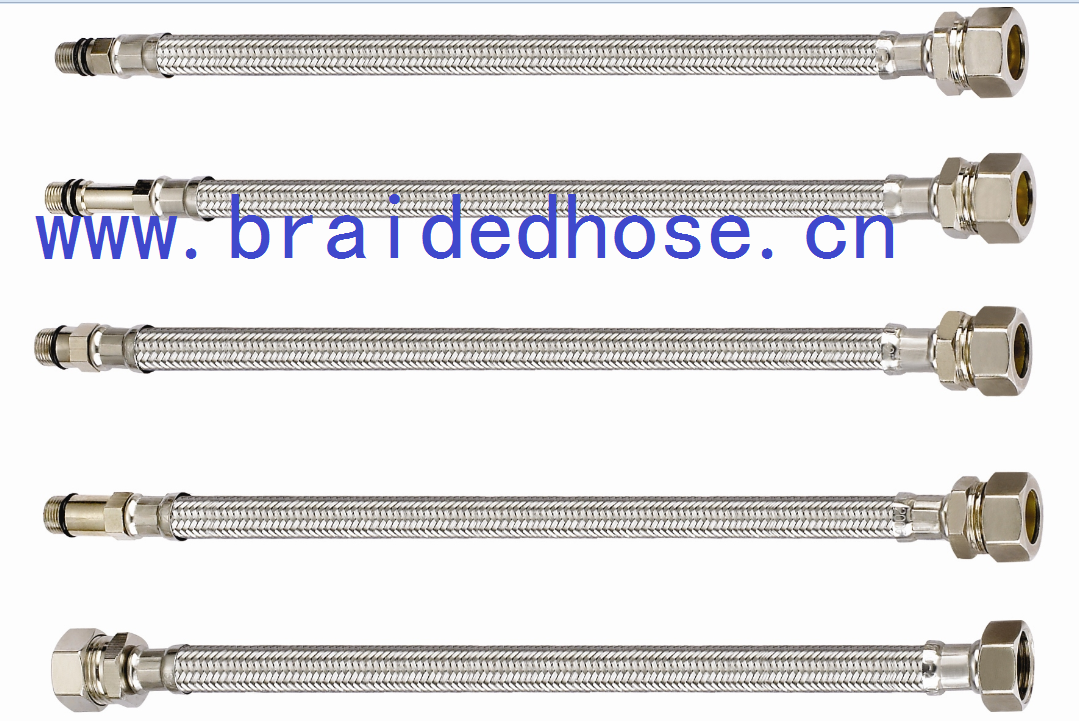
This hose connects the toilet tank to the wall angle stop valve for water inlet. Its standard structure:
1. Outer layer: Preferably SUS304 stainless steel braided mesh, explosion-proof, pressure-resistant and corrosion-resistant.
2. Inner tube: EPDM or nit-rile rubber tube for leak-proof sealing.
3. Connectors: Thickened brass nuts with sealing gaskets, featuring universal G1/2 (4-point) thread fittings, compatible with most household toilets and angle stop valves.It is used for cold water supply, combining flexibility, high pressure resistance and burst resistance, ideal for humid bathroom environments.
Key Selection Guidelines
1. Material certification: Choose products clearly marked with 304 stainless steel (avoid rust-prone 201 stainless steel) and implementing standards (e.g., GB/T23448); reject unbranded products.
2. Length measurement: Measure the straight distance between the angle valve and the toilet water inlet. Select a hose 2–3 cm longer than the measured size. Common specifications: 30 cm, 40 cm, 50 cm, 60 cm. An overlong hose accumulates dirt; an undersized one will be overly tensioned.
3. Pressure rating: Household water pressure ranges from 0.3–0.6 MPa. Select hoses rated for 1.0 MPa or above.
4. Accessories: Prioritize models equipped with matching sealing washers and simple installation wrenches.
Installation Steps
1. Water shutoff: Close the angle stop valve and drain residual water from the old hose.
2. Interface cleaning: Wipe the threads of the angle valve and toilet water inlet; check for burrs or corrosion.
3. Sealing treatment: Wrap 3–5 circles of PTFE tape clockwise around male threads, or use the original attached sealing gaskets directly.
4. Connection and fastening: Screw on both nuts by hand first, then tighten an additional 1/4 to 1/2 turn with a wrench. Do not over-tighten violently to prevent cracking of brass connectors.
5. Pressure testing and leakage inspection: Slowly open the angle valve, check all connections for seepage, and confirm no water leakage after several minutes of pressure holding.
Daily Maintenance & Prohibited Operations
1. No sharp bending: Avoid sharp 90° bends near connectors; excessive bending causes fatigue damage to the inner rubber tube.
2. Regular inspection: Check every six months. Replace immediately if there are tube bulges, broken braided wires, joint seepage or aging gaskets.
3. Service life: Full replacement is recommended every 3–5 years. Shorten the service cycle for high-rise buildings or areas with fluctuating water pressure.
4. Environmental protection: Keep away from sharp objects and long-term contact with acidic/alkaline detergents to prevent pipe damage.
Common Misunderstandings
· Distinction between stainless steel braided hoses and stainless steel corrugated hoses: The former is flexible for short-distance flexible connection; the latter has high rigidity and deformation resistance but poor bend-ability.
· Using 201 stainless steel instead of 304: 201 steel rusts easily in humid bathrooms, shortening service life and contaminating water quality.
- No.388 Shupu North Road ,Lucheng Light Industrial Zone,Wenzhou City ,Zhejiang Province China
- Tel : +86-13758897904
- Fax : +86-0577-56768888
- Email : sales@braidedhose.cn
- Website : http://www.braidedhose.cn